Friday, 17 May 2013

PlyPi Plans


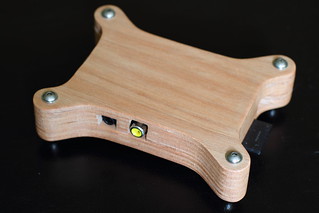
For a long time now, people have been asking for the plans to the PlyPi.  I'm afraid life (and all that entails) has got in the way.  But now, behold!  I've got the plans scanned into a PDF file.  They even seem to print at the right size on my end (which, in my opinion, is as close to a miracle as anything I've ever seen).  So hopefully they will be useful to you.


Raspberry Pi - PlyPi - Case (Audio/Analogue Video)

One thing I managed to leave off the accompanying text - it's of course possible to make the PlyPi without an HDMI socket hole.  You might need to adjust the plans a little - but really, the skies are the limit!  Well, they are when you attach a RPi to a weather balloon, anyway...

If you're pleased with the plans, please consider sending a small donation.  It might not seem much, but it might make a huge difference to me.

Anyway, have fun!


The PlyPi Plan


Wednesday, 1 May 2013

BADD2013: Demi-Wife (3/3)

All the time that I've spent thinking about writing this blog post, I have had The Decemberists 'Crane Wife' in my head. As such, I suggest you give it a listen as you read (or see the lyrics here and here).

As much as the tech I've written about makes me a very lucky chap indeed, there's something that makes me even luckier. It makes a lottery win look mundane. A narrow escape from a sticky end seem every day. A large portion of chips when you only ordered a regular...well...perhaps it's on a par with that.

What am I talking about? Well, I am now (sort of) Mr Goldfish. Deborah and I recently went to Weybridge registry office in the middle of an unseasonable blizzard (which I choose not to take as some kind of supernatural sign) and got legally hitched. Not that things are ever that straight forward for us. And the funny thing is, that's not actually a bad thing at all.

You see, with our health, Deb and I are both used to the concept of pacing. We have to take weeks to accomplish something someone might do in an afternoon. We break up the task with rests, sometimes having to change to a different task if, for example, it is something which, done too often, leads to a dramatic increase in pain. Pacing. It's one of the greatest leasons a chronically poorly person can learn. Because without it, it's all too easy to become frustrated.

I have noticed, however, that when applied to something like a wedding, which is a very public event and one which involves other people directly, if they don't get the concept of pacing, they can misread the event entirely.

Our registry office do became significantly larger than we'd anticipated. Honestly I think we'd both felt that we might have two parents there, mainly as wheelchair pushers. Four parents max (which is lucky as we only have the four). This number tripled. Not that that's a bad thing - it was very nice having everyone there. But an event which we thought of as just a legal doodah suddenly became quite a bit more daunting.

Registry office group portrait
Deborah, Stephen, Granny, Alex and Sophie.
Sophie might have been a bit happy, but it's so hard to tell with her.

This does serve as a prime example of why pacing is so important - it took us quite a while to recover from such a big event. If we'd tried to do things traditionally, we'd not have made it through the day.

So come late July, we'll be finishing the job we started with our own, specially planned day with the absolute minimum of stress and with everything carefully planned. And of course, those plans will never go absolutely smoothly, but because of the way we're doing things, if there is a hickup, we will be able to raise our voices, shout 'All right you horrible lot, we're starting that bit over and stop your complaining' and everything will be fine. Having such a period of time in between means that we have been able to spend time organising one section without worrying too much about the next. And we should, barring Deb's toe trying to fall off, be as healthy as possible come the day.

My parents get this - my mother's chronically ill and my father has worked in special schools most of his life. Deb's parents find it a bit more difficult to fathom, but are doing surprisingly well. I think that they saw that the registry office do really wasn't that meaningful and I think, as time moves on and the concept of a fish and chip wedding lunch becomes a bit less alien, they can see why this means so much to us. It's also, I hope, clear to see that we're both truly excited about July.

But I am aware that, because our marriage will not be conventional (which, as much as I could try to blame it on disability, is perhaps equally to do with the kind of people we both are), there are people who might not quite get it. In the same way that same-sex marriage, or inter-faith marriage, or, heaven help us, marriage between people who feel differently about chorizzo sausage, might be considered not quite official and meaningful. Not quite real.

But what do they matter?

In other posts I've spoken about tech, both special and widely adopted, and how important it is to me. So I wanted to tie them together with the wedding.

Firstly, walking sticks.

You know that a walking stick is an intrinsic part of your sense of self when you're watching a good film, have sunk so deeply into it that you have become the hero, and, watching them wander out of their front door, think to yourself, "Idiot, you've forgotten your walking stick!"

My walking stick is a part of me. And so, I have to have the right one for the wedding. Yep, I have several! And as I try to create the perfect ensemble (more on which later), so I have to choose the perfect stick. Should I choose the eagle-headed stick? The dragon from Cyprus my father picked up for me? Or should I go with the knobkerrie my sister bought me when she went up Kilimanjaro? I'm still not 100% certain, but I think I am favouring the dragon.

I hope that being able to consider my stick as an intrinsic part of the outfit means that I am fully accepting of it as a part of who I am without that having any negative connotations. In the same way as I am accepting of my glasses.

Cassie, Stephen and partly made shoes
Cassie inspected my partly-made shoes from
Green Shoes, and decided that they really should
have been black...
Then there is all the help we've had from conventional tech. We booked the registry office on the strength of its website combined with the help of google maps and streetview. EBay has been our constant companion and, as Deb is making her own dress with a rather unusual fabric, we'd not have been able to source it easily any other way (although we did have some help from friends who could access charity shops...). I have always wanted a made-to-measure suit, and indeed I have one ordered. No visiting a tailor - Deb measured me up and everything has been ordered online from Suitopia. In a display of blatant greed, I have also ordered made-to-measure boots from Green Shoes to match. I will write more about both of these on another day - but as a disabled man who would have a slightly hellish time clothes shopping otherwise, these internet-accessable busineses have been a real blessing.

On the day, we want a small do. We'd not cope with having all of our friends there, and indeed, many of our friends would simply not be able to travel and cope with the ceremony. So we will hopefully be setting up a live video stream for all those people who can't manage it. This is, I think, one of my favourite bits of our system. It, along with several other ways of doing things, has made a day that will be inclusive. It will allow everyone to be involved in the ways they can be. And that is, at the heart of all things, the essence of love. Love is inclusion. An understanding and acceptance of people and things as they are. Love does not seek to change.

Which reminds me of this - perhaps one of my favourite bible verses;

Love is patient and kind; love does not envy or boast; it is not arrogant or rude. It does not insist on its own way; it is not irritable or resentful; it does not rejoice at wrongdoing, but rejoices with the truth. Love bears all things, believes all things, hopes all things, endures all things. Love never ends.
(1 Corinthians 13:4–8a)

So, in my mind, disability has helped to teach me all these things. I have become less rigid, more yielding, and yet I also have the strength to endure for the things I believe in. I have a confidence which does not stem from showing off. I do not look at the ways of others and feel envy, because I am certain of and happy with myself (whilst, I hope, being entirely accepting of other people's beliefs). And I know that, although disability can make me feel physically fragile, I can see my soul underneath and know its nature. And that it is eternal. 

All that because I'm poorly. And because I met the right poorly girl to share a world with. A world which you're all a part of.

BADD2013: Tech Expands the World (2/3)

Sophie and Stephen reading
When caught without a copy of the Iliad to read
to an unsuspecting infant, a smart phone
really comes into its own.
Having written about special technology which would benefit from being diffused out into general usage, I would now like to write about general technology which makes my life as a disabled chap so much brighter.

My phone is with me all the time. And yet, I very seldom use it to talk (or even to text) people. It is there
almost exclusively for internet related jobs. Now, I know that this is quite normal. Everyone with a smart phone has the same access to information at all times. So why do I feel that it especially benefits me as a person with a disability?

  • Weight - my laptop isn't a heavy one, but when in pain, it can be hard to rest a laptop on my lap without it being a bit uncomfortable. With a phone, it can be propped or held with minimal physical effort. It's also possible to hold it at angles with which my laptop would not be happy. So on those occasions when my body needs to be bent in such a way as to resemble a slightly deformed pretzel in order to gain some relief, I can still shop on eBay. 
  • Noise - my laptop's a noisy old thing. It will need upgrading soon and hopefully the new model might be a bit more quiet, but even so there are mornings when I've woken up early, dreams interupted by the pain, and rather than switch on my laptop and risk waking up Deb, I'm able to use my silent phone.  (It must be noted that I have played YouTube videos, confident that Deb won't be disturbed thanks to the headphones I'm wearing, only to then find out that my headphones might be on my head, but they're not actually plugged in to the phone...)
  • Alarms - I remember my old gran's alarm clock. It had a red hand you moved to the time you wanted it to ring, and ring it would - with an actual physical bell. How on earth she coped with both the aural assault and the one alarm limit, I'll never know. My phone has a huge number of alarms set to ring throughout the day*. There are different tones to identify whether it's Deb or I who are being commanded to take tablets. Without these I know I'd be lost. And then there are the incidental alarms - something ending on eBay, a radio programme I might otherwise miss, or a phonecall I need to make. When lost in symptoms or drug-haze, a digital reminder can make life so much easier and safer.  
Whether on my phone or laptop, YouTube has become surprisingly important to me. I always rolled my eyes when people talked of YouTube being a threat to television channels, but it is so true in my case. I watch at least an equal amount of YouTube videos to actual television (excluding films). Every morning I check my YouTube subscriptions and recommendations. I will write more about these in the future, but each day I watch cheaply produced films made by amateurs who tell me more about interesting subjects than I am ever likely to see on television. This gives me a real sense of having learned about things; enriching my existence and making me a more capable human being, even if I'm not absolutely physically capable of all the things I've learnt.

Then there's social media. It's always hard when people attack social media as some kind of den of iniquity. It's usually people with no knowledge and experience who get the wrong end of a stick handed out by the dark drip-feed of a traditional media which lives in terror of its own death. Social Media is literally what you make it, because it is based on a society you have complete power over. Don't like someone on your feed? Like ancient Athens, you have access to the ostracons - you can exile them and rid your world of a dissenting voice. You can follow the lives of a thousand different people, and see what is important to them. The world expands, and so we care about each and every corner of it.

Of course, the downfall of this customised society comes if we forget that it is an individual construct and that a larger society outside of our direct and total control lives on and can threaten us (and, in turn, can be threatened and harmed by us). However, people can and have buried their collective bonces in the dust for millenia past - that's not going to stop over night. And Social Media allows us to monitor and talk about this Big Society in a way we couldn't before.

Also, when we do talk about things online, we're not limited to voice (or text). When Deb and I talk with family and friends, we're able to do so face to face. Skype really has made a huge difference to me. When I am away from my family, being able to call and both talk to and see them makes me feel much more at ease. Also, you get to see dogs who have relatively little to say on the phone.

Finally, there are the pictures. Call me infantile, but I like pictures. Picture books, photos, paintings, sketches, gifs... A picture paints a thousand words, and with flickr and facebook, instagram, 500px and yfrog, our world is full of beautiful, multicoloured thoughts and feelings we might never see otherwise - especially if we can't easily leave our rooms. I love it when someone photographs their lunch. I welcome every picture of a yarn-bombed tree. Each carefully quilled portrait and beautifully lit news-story. The internet, however I access it, broadens my horizon quite literally and I love watching the world through the eyes of the infinite. 

Other than the physical comfort afforded by my phone, there is an overarching theme to all these things - the lack of mobility that disability enforces, and the shrinking of ones' world thanks to social prejudice. But not only has tech allowed us access to socialisation, shopping, learning and the free and natural beauty of the world (and people's interpretations of it), it has also allowed us the opportunity to project ourselves into the public conscious. The possibility that someone can see your face rather than just talking to you on the phone** means that the exquisite variety of disabled faces become less radical, and so makes them more easy to appreciate and admire. Social media allows for energy-efficient communication with a large number of people, and also helps to empower (even though I worry about the nature of some disability cabals on the net). And If I can watch a video on woodworking and comment on it as a disabled man who has an interest and appreciation of such things, then the carpenter who made it can know that someone who can't just pick up a hammer cares as much as he about such a large part of his life. We are joined, no matter how briefly, and the social restrictions and prejudices fall away. Tech has the great potential to project our souls out into the world where it is not easy for us to be. And I believe that this will help to change the world in ways that will make it easier for us to inhabit it.

So thank you, world. Thank you for bypassing some of the restrictions on my life through widely adopted tech. It makes me happy and hopeful.

*I even had an alarm go off on the way to the registry office - In 15 minutes you need to get married, my phone told me.
** The possibility of skype calls with doctors is something I'm very much hoping for.

BADD2013 - A Sticky Situation (1/3)

There was a time when speech recognition software was about as specialist as tech got. I remember in the dark old days of Dragon NaturallySpeaking 4 wowing people with the barely understandable translations offered me after an hour training my PC to the individual cadence of my speech by bellowing out, steadily, in a Newsreader voice, a section from Alice in Wonderland. Things move on, and now, not only has the process simplified remarkably and become a genuine alternative to typing (almost), the integration of this tech into smart phones has removed the associations it once had with disability.

I recently read a wonderful article about disability in anthropology/archaeology on the same day that I read through one of Deb's blog post comments in which she explained how she interprets the Social Model of Disability. There is a simplicity about the concept I greatly admire - in fact, more than that, it makes me feel safe. All the best theories do, as they pin down the messes of reality into a manageable lump. So, in the words of Aimee Mann, this is how it goes;

Society is what disables us. And that disability can be caused by many different things - physical impairment, emotional distress and even prejudice itself. The impairments are unique and different, but we are united as a group by our universal experience of social disablism. 

My father is a great man. He has always kept me safe, whilst encouraging me to be as independent as possible. He has never felt embarrassed about my inability to do normal things, and, indeed, has never acted in a way that has encouraged me to feel embarrassed about my health and the accommodations needed to live with it.

In the last couple of years, my father's health has taken a turn for the worst. I always knew this would be a difficult time. Several times my father has said "It's a good thing you're poorly - I'd never cope as well as you do". And, indeed, he doesn't. But still, I wasn't expecting to hear from him what I did just a few months back.

"Well, I went down to the Post Office today with my walking stick looking like a really doddery old man."

I have been using a walking stick for many, many years. There was a time when I was embarrassed to use it; propping it out of sight if there was someone about who I didn't totally trust. But as I had fewer falls, felt more stable in general and could get in and out of chairs without copious groaning, I was able to get over it. And getting over it was, as with pretty much every problem I've ever had, something my dad's laid back attitude helped with.

A Pillbox sensitively labelled "Baldwin's Nervous Pills"
And yet he really struggles with his stick. And that's awful. Because he doesn't mind using this pillbox I bought him a while back. And perhaps most importantly because he's the one who actually bought Dragon NaturallySpeaking all those years ago. He sat there just as I did reading aloud out-of-copywrite text for hours on end to try to get the computer to recognise what he was saying. He didn't feel bad about it then - it was just another gadget to get excited over.

And this is what is so interesting - tech of whatever kind falls into a spacific space.

  •  Acceptable tech for general use. 
  • Specialist tech that remains funky. 
  • And specialist tech for the 'Special'. 
And it's not as if a walking stick has always been for the 'Special'. Take Beau Brummell. There's a rather wonderful statue of him in Jermyn Street, London - a road almost exclusively populated by posh men's clothing shops (what do you mean you didn't think I'd know about shops like that?). He stands there looking rather elegant and extremely confident. And although I'm not sure that a stick that delicate would be resilient enough for a chap of my weight, he brandishes it without the slightest hint of embarrassment.

"To be truly elegant one should not be noticed." 

Brummel said that. Now, I'm not sure I fully agree with him, but presuming that he wanted to be elegant, he wasn't going to be doing something which he felt would make him look "Special" in that horrible inverted commas kind of way. It was a gadget which was as stylish as it was functional. And this is why we should rethink the walking stick. I've seen some pimped walking sticks complete with torches, grabbers and panic alarms. But that doesn't equate to style. Style needs something a bit less worthy...

So my ideas for a new line of respectable walking sticks appropriate of all walks (and staggers) of life;

  • Sword Stick - there is something undoubtedly cool about a sword stick. I know they are incredibly illegal in most countries now. But in the UK at least, there has been a dramatic increase in incidents of disability hate crime on the streets. So would arming the disabled populace really be such a bad idea?
  • Medicinal Tipple Stick - I do not want in any way to encourage irresponsible use of alcohol (which says a lot about me when I have no problem at all with suggesting that disabled people should hack their tormentors to pieces), but the tipple stick was cool for many of the same reasons why I always wanted a sword stick. So, rather than secreting a stash of booze under the handle of your walking stick, why not replace that with a stash of medicine? But only the good stuff - the stuff a non-disabled person might be willing to knock over a Boots for. 
Obviously of the three, the GPS stick is the most sensible.  It is also, however, very exciting - we can incorporate tech into so many things, and with good design we can make them desirable and stylish. Imagine a swagger-stick with built in bluetooth connecting to your phone. A series of LEDs along the shaft of the stick scrolling messages from your twitter stream, sharing with the world the collective wit of your social circle.

Screenshot from the film Wall-e showing a levitating
power-chair user drinking from a large cup whilst our
hero, the yellow robot Wall-e, watches.
The dystopian horror of universal mobility in the otherwise excellent film Wall-e is its one flaw - the truth is that as soon as a technology loses its stigma, we open society up to true equality. And that equality does not mean that we all become lazy - indeed, that attitude just demonstrates an intrinsic belief that people who cannot walk are lazy wasters who aren't really trying hard enough. And it's all madness anyway - people expend energy driving themselves when they might be chauffeured via public transport. They walk and run and cycle for FUN. And they even visit gyms. And they do all of those things whether they're disabled or not.

Lazy people will always be lazy. But most people aren't, and having pieces of technology available which can help them when they need it and which, most importantly, don't make them feel doddery when using it, will only help to keep them active and productive longer.

Tuesday, 30 April 2013

BADD 2013

Blogging Against Disablism Day, May 1st 2013Tomorrow is Blogging Against Disablism 2013. This year I shall be writing not one, not two, but three shiny new posts in honour of Blogging Against Disablism Day 2013. This event allows people from all over the world to unite, writing on the theme of disability in our less than perfect society. The perspectives are as broad as you can possibly get, and I hope that my thoughts will help towards creating an interesting snapshot of the lives of disabled people in 2013.

So come back tomorrow for my three posts in honour of #BADD2013!

Wednesday, 23 January 2013

Mary Beard and the Sheela na gig


Doing my degree was a huge act of faith.  I knew that I would gain lots from the process, but so often a degree is seen as a means to an end - the end being employment.  I remember talking to one of the more coherent taxi drivers who ferried me back and forth from the hospital school I attended.  When I mentioned the possibility of doing a classics degree eventually, he was a bit astounded - who'd ever pay you to classicise?

And although there's not a lot of money in the field, there are positions of employment - jobs which I'm unlikely to ever be able to contemplate.  I'd love to teach in some way, but for the time being at the very least, this is out of the question.  How, then, do I not feel like I wasted the time, effort and money getting my classics degree?

Mary Beard is a classicist who has done very well for herself of late.  I don't think a month has gone by recently when she's not been on the BBC news site (although not always in full toga).  Her blog, A Don's Life, is very successful.  And she's presented some wonderful documentaries.  Of course, if you go on Question Time and deign to offer an opinion...

Have you ever come across a Sheela na gig?  These sculptures (often found on church buildings, particularly in Ireland) depict women spreading their vulvas for...well...the reason's a bit of a mystery.  Some people think that it represents the dangers of female lust.  Others that they're a simple fertility symbol.  I'm inclined more towards the theory that they are an image to ward off evil spirits.  So, why do I mention them?

Well, the furor over Mary Beard's appearance on Question Time resulted in a flood of vile misogynistic abuse on the net. Several times when I've written blog posts, Deb's warned me that there's the potential some twit might start trolling.  But the sad truth is that she's much more likely to be targeted   Women just attract more of this kind of cowardly bullying.

So Mary Beard was targeted - and how did she react?  Well, in my mind at least (which is a very odd mind and in no way representative) she took a leaf out of the Sheela na gig playbook.  Rather than retreating from the comments and insults about her genitalia, she replied, facing evil spirits with the full force of her feminine power (I know...I could hardly bring myself to write 'feminine power'...but bare with me, it is quite late and I lost some sleep last night).

Deb wrote a very important blog post about misogynistic bullying on the net, and she identified two damaging pieces of advice given to women dealing with this kind rubbish.  It's really worth reading the post, but, to very briefly summarise, the advice was to 'be nice' and to 'grow a thicker skin'.  A woman who has been encouraged to act in this way will never be able to deal with abuse head on.  She must ignore it and try to be as nice as possible in the hope of avoiding further attacks.

But Professor Beard did the most powerful thing she could - she named the abuse as clearly as possible.  It takes a lot of courage to actually repeat the nasty things said to you.  I remember my grandmother losing patience with another elderly lady of her acquaintance because she didn't feel capable of repeating in court the threats shouted at her by some yob because it was 'rude'.  Well, if classics as a subject taught me anything, it's that rudeness is sometimes entirely appropriate.  Also, it helps that Mary Beard, having read Catullus and the like, will be familiar with similar levels of rudeness, albeit tempered by poetic genius.  The Sheela na gig exposes her femininity (for whatever reason) creating an image of total honesty and power.  Mary Beard goes on Woman's Hour and uses the word 'vagina'.  In fact, she uses it in relation to her own body.  In doing so, she regains complete ownership of herself*.  And the evil spirits depart.

She has done this for the benefit of those weaker than she.  Those who are harmed more deeply by these silly people.  And what's more, she's calmly addressed the aggressors and, it would seem, has been successful in reforming them (for some time at least - I'm not ever so optimistic about such people) thereby making the world a better place for everyone.

So why do I feel like I didn't waste my time, effort and money getting a degree in classics?  Because my studies have bought my a little closer to heroic figures like Mary Beard.


*Not that I think Mary Beard ever lost ownership of herself - but I think that the abusers felt that they suddenly had some power and rights over her being.  I believe it is this confidence of ownership which allows bullies to do such awful things.  'It's my toy to destroy as I see fit...'

Monday, 5 November 2012

Office Party (A piece of Flash Fiction for Interzone Advent Calendar)

This has been written for TTA Press's yearly Advent Calendar of Flash Fiction (less than 1500 words...or bang on in my case).  As an avid Interzone subscriber, I've fancied giving this a go for a while.  I hope you enjoy it.

---

Office Party

Stephen Whitehead


Distant tinny music filtered along the metal corridors of the Epsilon Class Explorer Vessel, each note collecting a thin coating of rust as it went.  The vast pressure of vacuum caused dissonant groans as the panels of the ship’s skin shifted to bare the load.

Vast pressure of vacuum, she thought, gloomily.  Vast, silent pressure.  Briefly she toyed with the idea of spacing the entire worthless lot of them as they gyrated and flirted their way towards a paralytic coma.

“Christmas...” she sighed.

She’d grown up an Ep-Ex rat, living her entire life in the confined space of a ship designed exclusively to travel as far and as cheap as possible.  Not for her verdant vistas.  Even when they found an interesting spot in the galaxy, she stayed firmly in the cabin which was home, work and comfort.  She flew.  The crew explored.

The crew.  Every three years a new bunch of candidates.  Slung deep through the void on a gravity well and then cruising the solar currents in search of something new, interesting and, preferably, extraordinarily valuable.  Bunch of warp-drive wannabes.  Not one had any idea what their life would become.  They dreamt of glory and adventure but soon realised they’d have to drink away the next three years of their life or go mad in the dark expanse she so loved.

“The child is a King, the Carollers sing,
The old has passed, there's a new beginning...”

Not that drinking your life away was always a bad idea, she thought to herself, head dropping in defeat.

The damp tinsel tacked with hot glue and hope to the bulkheads wafted in the scant airflow afforded by the recirculation unit.  The goldish fronds clumping like some wet animal.

It was at that point her entirely relative calm was broken.

Judd was a typical adventuring space pirate quarterback.  Why a six foot four pile of muscle and teeth would take a job in the cramped confines of a space craft, she couldn't....well, actually, she could guess.  On his bare bicep was a passable representation of the ship complete with the date of departure and, rather optimistically she felt, return.  This was to be his great story.  No doubt he had already picked out the rocking chair from which he would recite great tales of daring do to the hundred or so grandchildren he could already name.  Juddson.  Judd Jnr Jnr.  Juddette.

“Join us!”  He gestured with a foamy bottle of many-times-recycled beer.

“I’d rather not.”  She turned away to the rows of instruments – lights with every right and reason to flash multicoloured.  This, however, did not deter him.

“Captain, I really feel like we've not hit it off like I wish we had...”

She aimed an eyebrow at him, usually enough to send any one of them scurrying.  But not Judd, probably thanks to numbing cheer.  He merely slumped into the worn foam sling-shaped navigator’s perch, his bulky knee thudding against her dainty zero-g adapted joint.

“ I've got a story for you!” he enthused, his face bursting into a sly grin.

“Ooooohhhh...” his face fell and she marginally corrected the nosedive of her response, “...good.”  Her tone didn't rise with any hint of enthusiasm, but a lack of outright threat seemed enough to convince Judd that his story was perhaps the greatest idea he’d ever had.  To be fair, she thought, this could well be the case.

“There was this other Epsilon class a few years back a mate of mine was on, came across a habited world covered in the greenest grass you've ever seen.  Fruit growing everywhere.  Only two species of sentient life on the whole planet – some sea mammals look like bright orange whales filtering algae in the seas – and these furry little primates who harvest fruit on the land.  No biggie, right?  No real trade potential – the algae wasn't bad, but eat a bowl and you end up as orange as the whales.”

Despite herself, the captain snorted – the irony of a drink-flushed boy criticising those of unusual hue was unintentionally hilarious.

“No language, no buildings, no clothes even.  They spent all year wandering around naked eating fruit and getting fat.  They sound simple, right?  But they had this weird orb thing, some kind of computer.”  He flicked idly at a kumquat-sized glittery bauble precariously attached to the main engine core release.  “ Didn't seem to actually do anything for them, but every few days the primates came over and pressed their hand against it,” he let the shiny ball roll against his hand, “and there’s this flash of light and...well...nothing.  Tech guys figured it to be some kind of scanner.”

She was impressed, thinking that the orb would turn out to be a weapon and the story inevitably descend into epic, culminating in an intergalactic battle for Truth, Honour and probably some kind of apple based pudding.

“So, anyway, as they’re observing, winter comes by,” he gestured around at the tinsel, as if it spoke of something as organic as a season,  “and by come by, I mean WHAM, two days later the grass is all sparkly white and even the seas have iced over.  The whales dived deep and entered some kind of hibernation.  But top side is where it gets interesting.”

He leaned closer, voice dropping.  She could smell the stale booze on his breath and the biological results of scant water reserves.  His eyes, though, still sparkled and she found herself unwilling to halt the story.

“When warm, the little guys were all spread out across the land.  But as soon as it got chilly, they scurried back to the orb, clustering around it like it was some great big heater.  And the techs said that yes, it was giving off a faint heat.  Like, maybe, a couple cups of coffee-worth!  But still, they snuggled up close to it, maybe ten thousand of ‘em.  We threw up an IR filter, and sure enough, right at the centre they were warm as an ostrich in clover,”

She blinked, but he didn't pause.  Or explain.

“...and they kept moving, milling around like a mass of electrons circling the nucleus of an atom.  But those little electrons, they started to fade.”

He flicked the sparkly decoration, sending it spiralling around madly.  Light caught and flickered across the room.  Irritated, she grabbed at it, carefully lifted it from the bank of switches, placed it under the heel of her boot, and with one deliberate squeeze, shattered the delicate ball.

He gulped.

“Get on with it, okay?”

“Okay,” he mumbled, suddenly much less sure of himself.  “Er, the ones on the edge started to die.  Just not warm enough, right?  But their friends didn't stop to mourn or bury or burn or whatever.  They just kept moving with three or four dying every hour.    Soon there was a thick wall of furry frozen bodies surrounding this circle of little guys buzzing about.  And the more died, the less the wind got in.  But the less heat they were all producing.  So it kept pretty stable.  And this carried on for well over a hundred cycles, them getting thinner and thinner and the bodies piling up.”

She almost asked why no one did anything to stop this, but everyone knew that you couldn't interfere.  You could convince them to sign away half the wealth of their entire planet in exchange for a plastic singing Santa (and given the distant rendition of ‘Rocking Around the Christmas Tree’, she could almost support that policy), but stop a race from wiping themselves out and suddenly you weren't respecting their cultural autonomy.

“And all the time they kept touching this orb thing.  It was only by the time the numbers were way down, less than a hundred, we realised that the flash of light changed with the different beings.  What’s more, the shorter the flash, the closer to the edge they then went.  The longer the flash, the closer to the centre they stayed.  Until finally only two were left.  And on that day, the winter lifted.  The grass was green in a few hours.  But,” suddenly the greasy smile returned, “there was one thing the pair were left to do...”

She looked at him, could barely bring herself to say it.  “Repopulate the planet?”

His face split open, emanating an horrific glee like radiation.

“Well I thought we might just start with dinner, but OKAY!”

As he leaned towards her, she thrust an arm forward, her nimble fingers catching his flushed nose like a prize salmon.

“All that was some kind of,” she paused, letting sufficient bile rise to colour her words bright green, “COME ON?”

He was struck dumb, the stinging pain of his predicament causing tears to leap to his suddenly fearful eyes.

She sighed, letting go of him abruptly so that he tumbled from his seat and landed in a crumpled mess on the chequer plate deck.

“Christmas.” she muttered under her breath as she left the room.